

.jpg)
Over the past decade, we have witnessed a radical transformation in consumer engagement in regulation in Australia. Previously, there was a saying that "regulation is something that gets done to consumers." Consumers had little input or influence on the process but had to reach into their pockets to pay for the outcomes.
We are now seeing a growing maturity in consumer-centric regulation, where consumers can influence and own outcomes. This is a far superior model for all concerned and worthy of study and repetition.
Make no mistake, it has been a challenging journey. Multiple approaches have been tried, and there have been painful experiences and missteps along the way. There are still pockets of resistance where traditional regulatory detailed analysis is needed.
However, the tide has turned, and the picture going forward looks bright. No one who has experienced a consumer-centric regulatory process wants to return to the traditional regulatory model.
Table 1. The ten fundamentals of consumer engagement, in order of importance
Because the downside is existential and the upside is real. Done well, engagement is a supercharger for company value and a strong antidote to serious problems. Done badly, or not at all, it is the road to destruction.
You are a regulated utility. Your consumers do not have a choice, they are going to pay and use your company irrespective of whether they like you or not. Your regulator is going to set your revenue according to well established rules. What can consumer engagement add? What is to be gained from the extra time, resources and cost of engaging with your consumers? After all, they are an annoying lot who complain plenty. Who needs that aggravation?
Competition analysis tells us that companies thrive when they listen well to their customers and act on their wishes. Conversely, companies die when they lose touch and become arrogant. On the positive side, the Australian Energy Regulator has articulated the benefits as follows:
On the negative side, as a utility in a monopoly position, your future is less secure than it appears. Even though your consumers are dispersed and poorly resourced, their collective voices can resound with government. In a crisis, when governments are looking to act, there is no easier, or more satisfying, target than the "greedy monopolist." There is a fancy name for this phenomenon: social licence.
Social licence is the community's goodwill that a business needs in order to operate, and it matters because holding every necessary regulatory and legal approval is no longer sufficient without it. Twenty years ago the term was little known. Now it is everywhere.
The phrase came out of mining. It was popularised by James Cooney, then head of external relations at the Canadian gold miner Placer Dome, who used the metaphor in discussion with World Bank officials in late 1997. His point was commercial rather than ethical: companies were losing money on community resistance when they tried to start or expand projects, and he likened that opposition to a government refusing a permit. The idea travelled quickly from mining into forestry, farming, energy and infrastructure.
The concept bites differently for a regulated utility than for a competitive business. A supermarket that loses public goodwill loses customers, and the loss shows up in its accounts within months. A monopoly network cannot lose customers, so the same loss surfaces somewhere else, and it arrives later and larger: as a rule change, a rebalanced framework, a removed right of appeal, or a minister looking for a target during a price crisis.
That is why social licence is a financial question for a network rather than a reputational one, and why the examples in the next section are all cases where the bill arrived through the political system rather than through the market.
Governments intervene, and the intervention outlasts the incident. The rise of social licence is, in part, a response to high-profile incidents of poor conduct, and there are many.
Billions of dollars returned to customers. Thousands of pages of new laws. Reams of court cases chastening wrongdoing. Not to mention the careers ended (senior executive and board), the regulator humiliated and the companies no longer operating. The Australian Government established the Royal Commission into Misconduct in the Banking, Superannuation and Financial Services Industry on 14 December 2017. At the time there was an expectation that some degree of misconduct would be unearthed; no one anticipated the breadth and seriousness of the issues. Perhaps the most grievous was continuing to charge fees to people who had died. The final report concluded:
In 2005, new economic regulation legislation and rules were established for energy networks in Australia. The legislation and rules were highly supportive of the entities that were regulated, including a favourable merits review framework. Following a series of large price increases led by the regulated networks, action was taken. First, the supportive rules were rebalanced toward consumers. Second, the merits review framework was removed.
Figure 1. Australian energy regulatory decisions appealed under limited merits review, 2008 to 2016
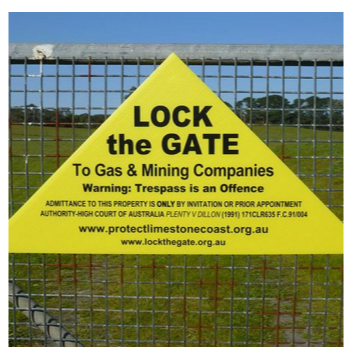
Source: Lock the Gate Alliance.
Bad behaviour by mining companies has led to strong community action to limit access. While initially focused on mining, community attention now extends to all types of infrastructure, including toll roads, airports, flight paths, wind and solar farms, mobile phone towers, gas pipelines and electricity transmission lines. Poor consumer engagement heightens community concerns, leading to delays and cost increases. The Lock the Gate Alliance, formed in 2010 after meetings of landholders and communities in New South Wales and Queensland, has continued to gain momentum over the decade since.
It looks quiet. There is no media attention, which is why good examples are harder to find than bad ones, and the clearest recent case is Powerlink Queensland in 2022.
The Powerlink Queensland electricity transmission decision in 2022 was a watershed moment. Powerlink approached its determination with the objective of putting forward a proposal acceptable to consumers, the regulator and itself. Its success meant both the regulator and Powerlink reached a final decision with modest effort and could focus on more valuable work. Most importantly, consumer acceptance of the outcome gave Powerlink more degrees of freedom in its operations.
Table 2. Outcomes of the Australian Energy Regulator's 2024 expenditure determinations
It is the single observable difference between success and failure. Two businesses ran almost identical engagement activities, one a remarkable success and the other a disappointing failure, and the distinguishing characteristic was involvement at the top of the organisation.
In the first, the board and chief executive made it a priority, engaged directly with consumers at events, and gave their teams authority to reach outcomes. In the second, the chief executive told staff to go away and do something on consumer engagement. There was no link back to the regulatory proposal, let alone to the day-to-day operation of the business. Staff had no authority to influence outcomes and consumers disengaged.
An example in the first class is Endeavour Energy in New South Wales. After observing its engagement, the regulator's Consumer Challenge Panel noted a highly functioning and extensive process, subject to regular, frank and honest review, producing a proposal widely supported as capable of acceptance. The feature the panel identified as key was that the chief executive, senior executives and board members were active participants, carefully listening, in every activity observed.
This principle is not just for the regulated business. It is critical that the regulator engages and adapts its own approach, because there is no point in consumer engagement if the regulator does not value it and give it weight. In any proposal it is possible to find small components unsupported by evidence. For the model to work, the regulator needs to be willing to step back and view the larger picture, which can be uncomfortable. There is nonetheless a high likelihood that the proposal in totality is better than anything the regulator could have achieved through its traditional tools.
Yes, and if you take one lesson from this paper, take this one. Attitude makes the difference between great success and destructive failure.
The first business came with an open mind, listened to its consumers and built its proposal around what it heard. Its consumers had genuine influence on the outcome. The second had already decided what it wanted to propose and went to its consumers looking for a tick of approval. Consumers may lack resources, but they are highly attuned to cynicism and know when they are being railroaded. The process then descended into farce. The regulator was also alert to the situation, recognised it could not rely on the representations of the business, and brought its assessment tools to bear in full measure.
It is better to do no consumer engagement at all than to undertake engagement with the wrong attitude.
The regulator refers to this principle as sincerity of engagement: genuine commitment extending from boards and executives down through the business, openness to new ideas and a willingness to change, ongoing engagement about outcomes that matter to consumers so that they can set the agenda, and measures that give consumers confidence in the process.
Table 3. Better Resets Handbook expectations for a network proposal, and the reward for meeting them
Mostly you grow them yourself, over years. Finding the consumers to engage with is perhaps the hardest part: they are busy, dispersed and poorly resourced, and the regulator needs confidence in the ones taking part.
These consumers need to be sufficiently mature to understand the choices and trade-offs they are making and then take responsibility for the outcome. There is no easy solution. It is rare to find consumers ready, equipped and willing to engage in these processes. Peak bodies exist, but they face multiple challenges and may struggle to represent consumers in general.
The best solution seems to be for regulated businesses to grow their own consumer groups, typically comprising representatives from peak bodies, large users and smaller users. This is a long-term commitment; it takes years for consumers to become sufficiently conversant with the business, the regulator and consumer interests more generally.
When putting a group together, the strongest voice should come from consumers who face the final bill. In a world of social licence it is helpful to have broader perspectives: people who see your transmission lines, those who live on the water table beneath your assets, welfare groups that look after the flora and fauna on the land you use. Avoid including people who supply services to your business, including unions, as these groups have different incentives because you pay them.
The area where consumer groups feel most exposed is the technical detail of the business and its cost drivers. Providing access to independent expertise helps, as does the regulator, which holds detailed data and benchmarking analysis and can outline the "tram tracks" within which outcomes are likely to be acceptable. The regulator can also grow consumers directly. Government funding allowed the establishment of a Consumer Challenge Panel, which advises on whether the long-term interests of consumers are being considered and assesses networks' engagement. The panel laid an important foundation, developing a cohort of consumer advocates who then trained others.
All year. The best consumer groups operate continuously outside the regulatory process, with special resourcing and focus while the proposal is being developed.
The businesses that do this well make a substantial resource contribution, both in access to their people (including senior staff) and in direct financing of consumer participation. Be upfront with potential candidates so they know the commitment they are making. Those that do it well see little turnover in their groups.
One of five incentives, and the most powerful of them was the removal of an obstacle rather than the offer of a reward. In some cases there are natural incentives to negotiate outcomes with little regulatory input, but in most the balance between supplier and consumer is not sufficient and something else is needed.
Natural countervailing power exists where consumers are large and well resourced, as in gas transmission in the United States and airports in the United Kingdom. Elsewhere, five incentives are observable. The first is self-starting: the best businesses report that engagement makes them better companies and would continue it regardless, with engagement written into senior executive performance agreements. The second is reputation, where positive reviews from consumer groups and the regulator are themselves sufficient, and negative reviews a real cost. The third is an easier regulatory process, which is the route the Better Resets Handbook takes.
Table 4. The five incentives for consumer engagement, with provider, reward and evidence
The fourth is financial reward, which is a tricky space with few examples, since the counterview is that consumers end up paying more for something the business should be delivering anyway. Victoria's PREMO scheme is the clearest case.
Table 5. PREMO ratings and allowed return on equity, Victorian water price review 2018
The fifth is merits review, and it works in reverse. Merits review is a clear inhibitor of engagement. If businesses are dissatisfied with the regulator's decision they have an option for a second decision, and setting up for it requires the initial proposal to be presented in a technical and legal framework that is not at all conducive to consumer access. The removal of merits review in Australia has been the pre-eminent catalyst for the transformation now under way. Beyond the prospect of a better outcome, boards are conscious of the risk of shareholder action if they do not pursue every avenue for improving shareholder value.
Multiple complementary ones, and this is the least important question in the paper. In the early days some businesses would approach the regulator and ask for a checklist of activities, which completely missed the point.
That said, the activities are not unimportant. A well considered and broad engagement plan is essential, and such a programme takes considerable time to execute. If you have not started at least eighteen months before lodging your proposal, you are in big trouble.
I was delighted that MCC's work was completed on time, and within budget, helping us deliver important changes and improvements, to the benefit of our stakeholders. MCC's report is published on the CCC website.

I am delighted to recommend MCC Economics. Specifically, I worked closely with PJ, who helped us with our Nuclear and CCUS projects. PJ helped us develop new policies and answer questions from our stakeholders. His support helped us deliver important changes and improvements, to the benefit of our stakeholders.

MCC Economics has helped us better understand the most important issues for our stakeholders, including: charges, shareholder returns, debt payments and inflation impacts.

I am delighted to recommend PJ and his team at MCC Economics. We've been working together on National Policy Statements to help meet net zero targets for 2030 and 2050. We initially appointed MCC Economics to support us on offshore wind consultation analysis and have recently reappointed MCC Economics to undertake a larger consultation analysis role across all sectors, including hydrogen, CCUS and networks. I can confirm that PJ and his team have shown excellent spreadsheet skills, alongside very good project management, planning and analysis skills, helping us deliver important changes, and continuous improvements, to the benefit of our stakeholders.

I am delighted to recommend PJ and his team from MCC Economics. They helped us with our price controls for Heathrow airport and for NATS (En Route) plc (the air traffic services provider). Specifically, the MCC team helped us deliver important changes and improvements to our financial models and supporting policy documents, to the benefit of our stakeholders.

I am delighted to confirm that I worked with PJ on a retail project in 2015. The project helped stakeholders understand electricity costs and charges. Specifically, the project helped us explain to stakeholders, internally and externally, why electricity charges differed across the regions (GB, NI & Ireland). PJ was a key member on the project team, which helped deliver changes and improvements in the understanding of energy retail.
.png)

Evidence-based analysis for transparent, defensible, and effective decision-making.
© All rights reserved – MCC Economics 2026.





.jpg)
