OETC price controls: how Oman regulates its electricity transmission revenue
A 30-minute recorded case study from MCC Economics. It shows how the revenue of Oman Electricity Transmission Company (OETC) is set, from the building blocks of Maximum Allowed Revenue to the incentives on spinning reserve.
Learn from practitioners with direct experience in electricity regulation, price controls and financial modelling.
Course lead
PJ McCloskey
Director, MCC Economics
PJ has worked on price controls from the regulator's side and for regulated companies, including RIIO-2 work with Ofgem and the Utility Regulator for Northern Ireland.
ACMA chartered management accountant
MSc Finance (Distinction), Birkbeck
Specialist in cost of capital and financial modelling
I heartily recommend PJ to anyone seeking input on the financial parameters that underpin different regulatory models.
James Veaney, Deputy Director, Electricity Sector Price Controls, Ofgem
Quick Answer
Price Controls 231 explains how Oman Electricity Transmission Company earns its regulated revenue. You learn how the Authority for Public Services Regulation (APSR) sets Maximum Allowed Revenue from operating costs, capital costs and the weighted average cost of capital, how it assesses grid investment for efficiency, and how incentives apply to spinning reserve.
Key takeaways
OETC is the sole licensed transmission and dispatch operator in Oman, so regulation, not competition, sets its revenue.
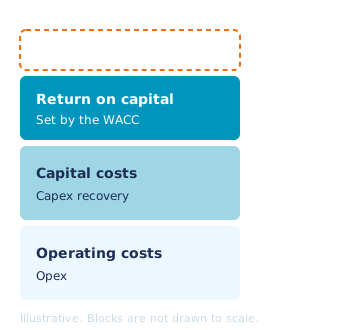
Maximum Allowed Revenue is built from operating costs, capital costs and a return set by the weighted average cost of capital.
APSR assesses strategic grid investment for prudence and efficiency.
Performance incentives apply to spinning reserve and system reliability.
What will you be able to do after the course?
You will be able to read an OETC price control and explain where each part of the allowed revenue comes from. The course is built around three outcomes.
Explain the governance. How OETC is licensed and regulated under Oman's Sector Law.
Break down the revenue. How Maximum Allowed Revenue is calculated from capital costs, operating costs and the cost of capital.
Judge the incentives. How spinning reserve incentives work, and where regulation is heading on digitalisation, resilience and performance metrics.
What does the course cover?
The lecture starts with OETC's place in Oman's electricity sector and then works through how its revenue is regulated.
Introduction
OETC in the electricity value chain: the Main Interconnected System
OETC in the electricity value chain: the Dhofar Power System
Maximum Allowed Revenue and its building blocks
How APSR assesses grid investment
Spinning reserve incentives and the direction of future regulation
What do the key terms mean?
These are the terms the course uses most, in plain English.
Term
Meaning
OETC
Oman Electricity Transmission Company, the sole licensed transmission and dispatch operator in Oman.
APSR
Authority for Public Services Regulation, the body that regulates Oman's electricity sector and sets OETC's price control.
Maximum Allowed Revenue
The revenue OETC is allowed to recover under its price control, abbreviated to MAR.
Building blocks
The method of adding up efficient operating costs, capital costs and a return on capital to reach allowed revenue.
WACC
Weighted average cost of capital: the blended return that debt and equity investors require, used to set the return block.
RPI-X
A price control that lets revenue rise with retail price inflation minus an efficiency factor, X.
Spinning reserve
Generating capacity that is running and synchronised to the grid, ready to respond quickly if supply is lost.
Who is the course for?
It suits people who work with transmission pricing or utility regulation and want a worked example from the Gulf.
Regulatory professionals and grid operators
Economists and engineers in transmission pricing
Infrastructure consultants in emerging markets
Students of energy systems and economic regulation
Which courses should you take first?
If revenue caps, building blocks or the cost of capital are new to you, start earlier in the Price Controls series. Price Controls 230 covers Oman's price controls more broadly.
MCC Economics advises regulators, government bodies and utilities on price controls, and its Gulf work includes the United Arab Emirates and Oman. The firm was founded in London in 2017. Its regulatory economics work covers energy, water, aviation and infrastructure. You can read the team's background on the people page.
MCC Economics has helped us better understand the most important issues for our stakeholders, including: charges, shareholder returns, debt payments and inflation impacts.
Leila N. Nasr, Section Head, Department of Energy, Abu Dhabi
Questions buyers ask before registering
Who teaches Price Controls 231?
See the course instructor profiles above for the current teaching team and their experience.
Is there a live session?
No. Price Controls 231 is recorded course material, so there is no meeting to attend. You get access to the materials as soon as you register.
How long does the course take?
The lecture runs for about 30 minutes. Allow a little longer if you want to work through the slides and the quiz.
What do I receive when I register?
A video lecture, the presentation slides, a full transcript and a short quiz to check your understanding.
Where do I pay?
Checkout is handled by Eventbrite, where MCC Economics and Finance is the organiser. The button on this page takes you straight to the course listing.
Do I need prior knowledge of price controls?
It helps. Price Controls 231 is an advanced case study. If revenue caps, building blocks or the cost of capital are new to you, take Price Controls 101, 120 and 130 first.
Can my team take the course together?
Contact MCC Economics through the consultation page to discuss access for a team or training tailored to your organisation.