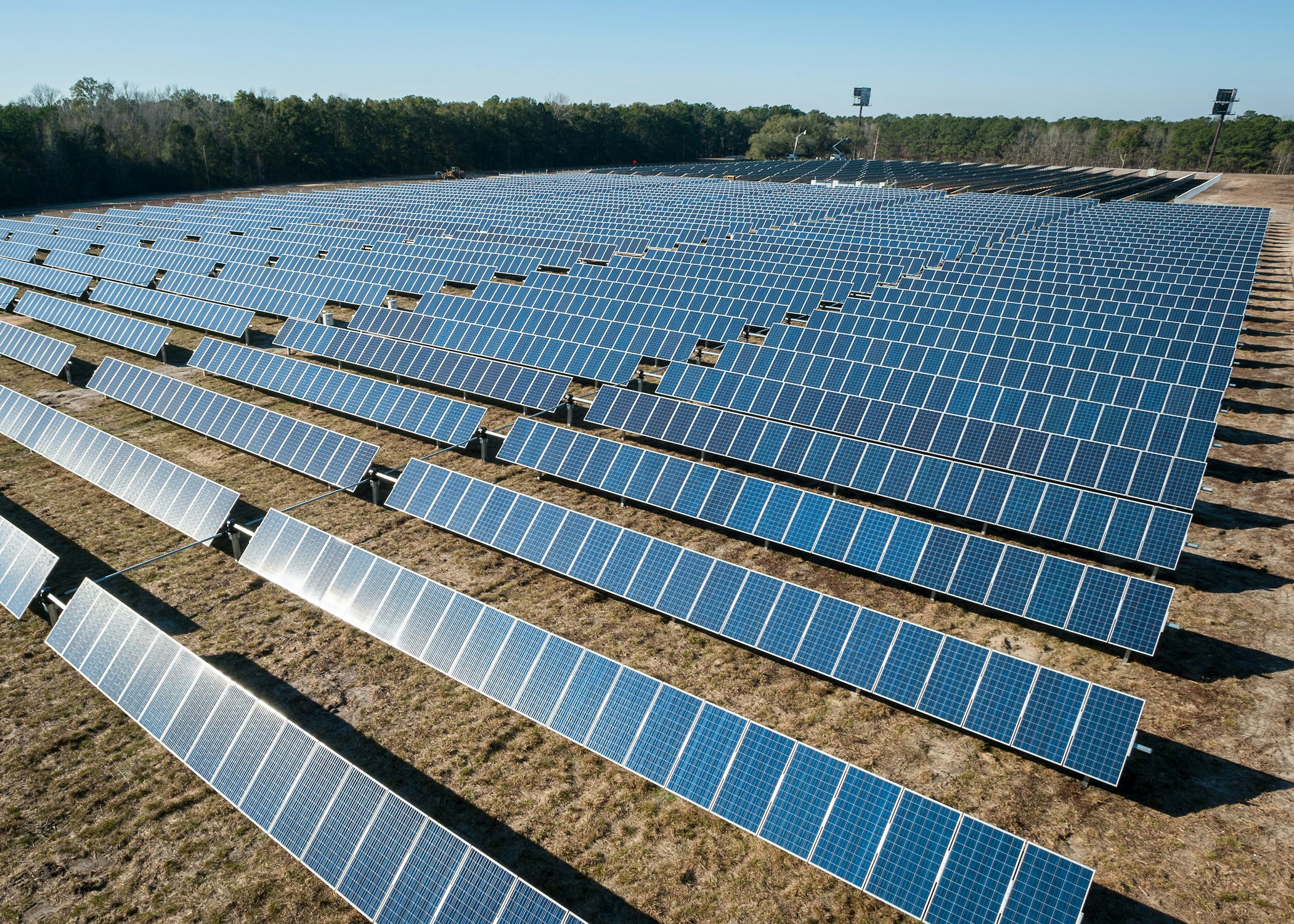
.jpg)
A single plant, about 55 kilometres southwest of Dubai Creek, built to supply a meaningful share of the city’s drinking water from the sea. Desalination is how Dubai gets most of its fresh water, and Hassyan represents the current state of the art: seawater reverse osmosis at unprecedented scale, run on solar power. The table below gathers the project’s key facts.
Table 1: The Hassyan seawater reverse osmosis project at a glance.
Source: MCC Economics summary of developer announcements and trade press reporting, as linked in the article.
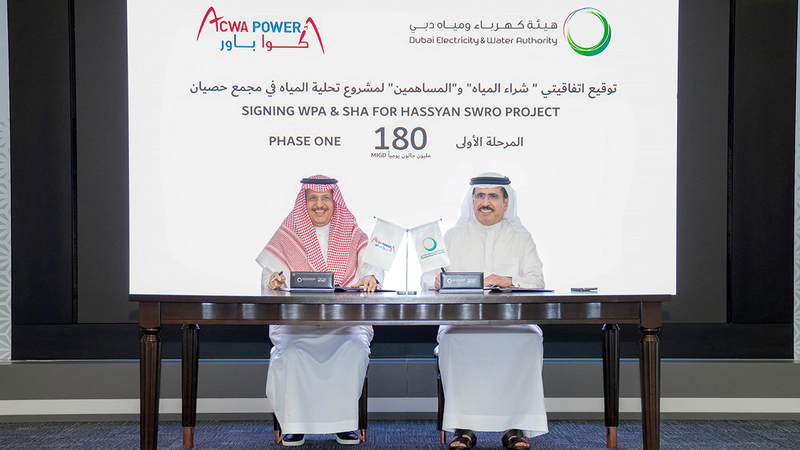
Figure 1: Representatives of the Dubai Electricity and Water Authority and ACWA Power signing the phase one water purchase and shareholder agreements for the Hassyan project. Photo courtesy of DEWA, as published with the ACWA Power announcement.
Because energy is the main cost of turning seawater into drinking water, and Hassyan will use less of it per litre than any comparable plant. Reverse osmosis works by pushing seawater at high pressure through membranes fine enough to hold back the salt, and the electricity driving that pressure has always been desalination’s economic and environmental weakness. Hassyan’s 2.9 kilowatt-hours per cubic metre represents about a 35 per cent reduction on the technology of a decade ago. Two further choices sharpen the gain: the plant runs on solar power, cutting the fossil fuel use and carbon emissions that usually accompany desalination, and it employs advanced pre-treatment and post-treatment processes that extend membrane life and improve water quality, as Veolia describes.
It is a cornerstone of both. On water, the plant contributes to the Dubai Electricity and Water Authority’s goal of raising desalination capacity to 730 million imperial gallons a day by 2030, securing supply for a growing city in one of the world’s driest regions. On energy, running the plant on solar aligns it with the Dubai Clean Energy Strategy 2050 and the Dubai Net Zero Carbon Emissions Strategy 2050, which target fully clean energy sources. Hassyan is where those two agendas meet: water security delivered without adding to the emissions the energy strategy is trying to remove.
Figure 2: Mohammad A. Abunayyan, Chairman of the Board of Directors of ACWA Power, and his statement on the Hassyan agreement, as published in the ACWA Power announcement.
The project sits near the Jebel Ali Wetland Sanctuary, and its design incorporates measures to protect local biodiversity, including endangered turtle nesting sites. That matters because large coastal infrastructure and sensitive marine habitats are usually in tension, and how Hassyan manages that tension will be watched as closely as its energy numbers.
Because Hassyan sets a benchmark other water-stressed regions will measure against. Combining record energy efficiency with solar power at this scale is a proof point that desalination, long criticised as energy-hungry, can be made compatible with clean energy goals. For governments, utilities and investors weighing water infrastructure across the Gulf and beyond, the project’s cost, energy and delivery figures will become reference numbers, which is exactly why this page sets them out.
I was delighted that MCC's work was completed on time, and within budget, helping us deliver important changes and improvements, to the benefit of our stakeholders. MCC's report is published on the CCC website.

I am delighted to recommend MCC Economics. Specifically, I worked closely with PJ, who helped us with our Nuclear and CCUS projects. PJ helped us develop new policies and answer questions from our stakeholders. His support helped us deliver important changes and improvements, to the benefit of our stakeholders.

MCC Economics has helped us better understand the most important issues for our stakeholders, including: charges, shareholder returns, debt payments and inflation impacts.

I am delighted to recommend PJ and his team at MCC Economics. We've been working together on National Policy Statements to help meet net zero targets for 2030 and 2050. We initially appointed MCC Economics to support us on offshore wind consultation analysis and have recently reappointed MCC Economics to undertake a larger consultation analysis role across all sectors, including hydrogen, CCUS and networks. I can confirm that PJ and his team have shown excellent spreadsheet skills, alongside very good project management, planning and analysis skills, helping us deliver important changes, and continuous improvements, to the benefit of our stakeholders.

I am delighted to recommend PJ and his team from MCC Economics. They helped us with our price controls for Heathrow airport and for NATS (En Route) plc (the air traffic services provider). Specifically, the MCC team helped us deliver important changes and improvements to our financial models and supporting policy documents, to the benefit of our stakeholders.

I am delighted to confirm that I worked with PJ on a retail project in 2015. The project helped stakeholders understand electricity costs and charges. Specifically, the project helped us explain to stakeholders, internally and externally, why electricity charges differed across the regions (GB, NI & Ireland). PJ was a key member on the project team, which helped deliver changes and improvements in the understanding of energy retail.
.png)

Evidence-based analysis for transparent, defensible, and effective decision-making.
© All rights reserved – MCC Economics 2026.