

It is a government-owned bank that invests in UK infrastructure alongside the private sector. The UK Infrastructure Bank (UKIB) joined a line of public institutions set up to speed up investment in the country's infrastructure. It launched in interim form in June 2021, with its headquarters in Leeds, and made its first investment that October. Its mandate is to support the transition to net zero carbon emissions by 2050. The UK Infrastructure Bank Act 2023, which received Royal Assent on 23 March 2023, sets out its objectives in law.
It invests across infrastructure sectors including clean energy, digital, transport, waste and water. It focuses on green projects, and it has attracted private investment into UK infrastructure from both domestic and overseas investors.
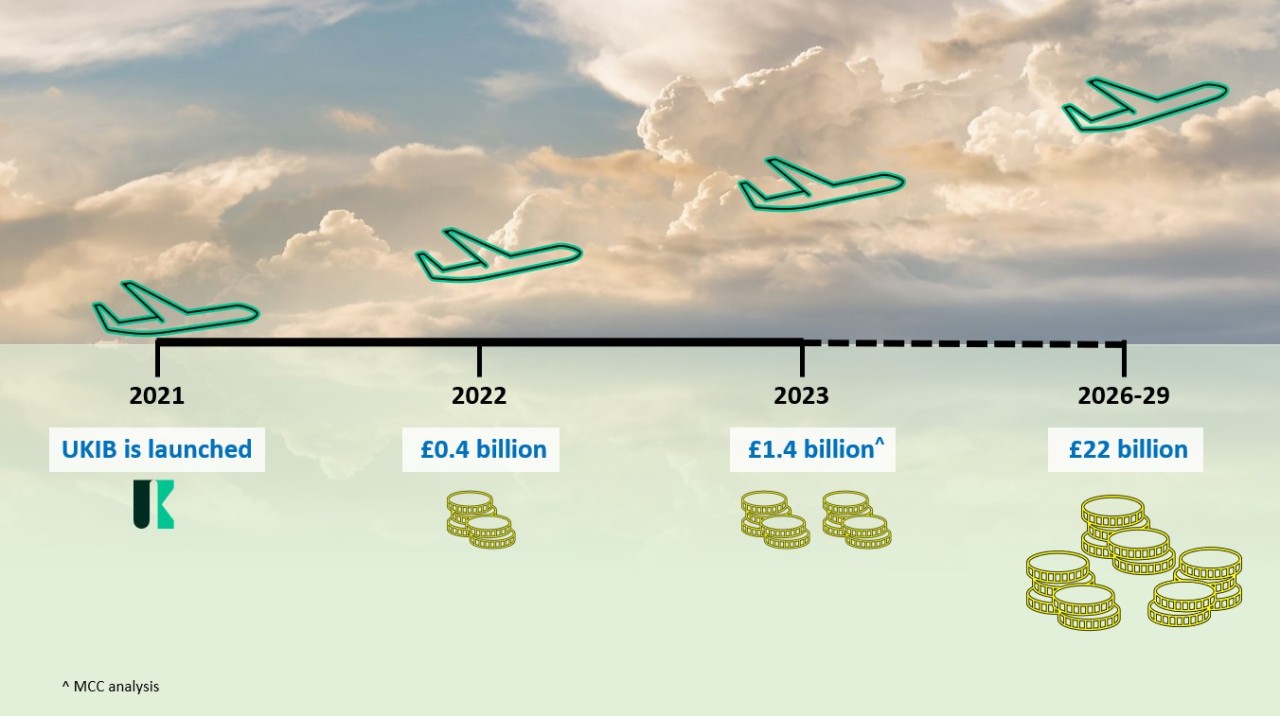
Figure 1: The UK Infrastructure Bank from launch to full capacity, 2021 to 2026-29.
Source: MCC Economics. The 2023 figure is MCC analysis.
22 billion pounds, split across three instruments. That is 7 billion pounds of debt, 5 billion pounds of equity and 10 billion pounds of guarantees, as set out in the Treasury's policy design for the bank. There is also a limit on how much can be used in any single year: 1.5 billion pounds of borrowing, 1.5 billion pounds of equity and 2.5 billion pounds of guarantees. The equity limit applies for the first five years, under the bank's framework document.
UKIB's money is available to private sector corporations, investment funds and local authorities.
Figure 2: UKIB financial capacity by instrument, overall and maximum per year. The per-year figure is part of the overall figure, not added to it.
Source: HM Treasury, Policy Design of the UK Infrastructure Bank, and the UK Infrastructure Bank Framework Document.
Yes. UKIB has a large sum to lend for corporate and project finance, and the money is cheap. Its accounts for the year ending March 2022 suggest an average interest rate close to 1 percent for its counterparties. That figure may be misleadingly low, because the reported values reflect loans that were only in place for part of the year. The published prices of individual deals are the better guide.
UKIB faces several key investment risks such as regulatory risks, market risks, and credit risks. However, it is well-equipped to manage these risks and ensure compliance with international obligations on subsidy control and future domestic regimes.
The UK Infrastructure Bank presents an opportunity for the country to leverage its resources to mobilise investment. The Bank is already providing expertise and capacity to local governments and help them realize their infrastructure plans. The Bank is also expected to help build back better, fairer, and greener by supporting the transition to net-zero carbon emissions by 2050.
In conclusion, the UK Investment Bank is a new institution with the potential to play a major role in the UK economy. The bank has made some early progress in making funding deals, but it remains to be seen how successful it will be in achieving its mandate. The future of the bank will depend on a number of factors, but it has the potential to be a major force for economic growth in the UK.
Table 1: The price of UKIB money in three published deals. SONIA is the Sterling Overnight Index Average. A basis point is one hundredth of a percentage point.
Five sectors: clean energy, digital, transport, water and waste. Clean energy and digital have taken most of the money so far.
Figure 3: The bank's five priority sectors, set by HM Treasury.
Source: MCC Economics, from the UK Infrastructure Bank Strategic Plan 2022.
About 2 billion pounds of commitments since the bank was set up, including these eight large deals.
Table 2: The UK Infrastructure Bank's largest closed deals.
Mostly into clean energy and fibre broadband, in almost equal shares. The bank has announced seven commitments in clean energy, potentially investing more than 800 million pounds in the sector. Fibre broadband is also set to benefit, with 775 million pounds committed across six deals in the digital sector. Together the two sectors account for almost nine tenths of committed capital.
Figure 4: Sectoral split of the UK Infrastructure Bank's overall committed capital.
Source: MCC Economics analysis of UKIB deal announcements.
No. UKIB faces regulatory risk, market risk and credit risk, which is the risk that borrowers do not repay. It is well equipped to manage them. It must also comply with the UK's international obligations on subsidy control and with the domestic subsidy control regime.
The bank gives the country a way to use public money to mobilise private investment. It already provides expertise and capacity to local government to help councils deliver their infrastructure plans. It is also expected to support the transition to net zero carbon emissions by 2050.
It has become the National Wealth Fund, with more money and a wider remit. On 14 October 2024 the UK Infrastructure Bank was renamed the National Wealth Fund, capitalised with 27.8 billion pounds and still run from its headquarters in Leeds. The fund aims to mobilise 3 pounds of private investment for every 1 pound it invests.
The bank's last full year as UKIB ended on 31 March 2024. In that year it signed 18 new deals. Since it was set up, it had committed 3.1 billion pounds and mobilised 10.5 billion pounds of private finance, according to its annual report and accounts for 2023 to 2024. The same report says that by late November 2024 it had announced 44 deals, deployed 4.7 billion pounds of capital and mobilised nearly 12.3 billion pounds of private finance.
The remit has widened beyond the five original sectors. In March 2025 the Chancellor published a statement of strategic priorities for the fund. It names clean energy, digital and technologies, advanced manufacturing and transport as priority sectors. It expects 5.8 billion pounds to go into carbon capture, green hydrogen, gigafactories, ports and green steel. It also raises the fund's economic capital limit from 4.5 billion pounds to 7 billion pounds. So the government's answer to the question in this article's title has been to give the bank more capital and a broader mandate.
It has the potential to be. The UK Infrastructure Bank is a new institution that could play a major role in the UK economy. It has made early progress in closing funding deals, but it remains to be seen how well it will achieve its mandate. Its future will depend on a number of factors, including interest rates, the quality of its borrowers and the policy choices of government.
We would be delighted to discuss any of these questions:
I was delighted that MCC's work was completed on time, and within budget, helping us deliver important changes and improvements, to the benefit of our stakeholders. MCC's report is published on the CCC website.

I am delighted to recommend MCC Economics. Specifically, I worked closely with PJ, who helped us with our Nuclear and CCUS projects. PJ helped us develop new policies and answer questions from our stakeholders. His support helped us deliver important changes and improvements, to the benefit of our stakeholders.

MCC Economics has helped us better understand the most important issues for our stakeholders, including: charges, shareholder returns, debt payments and inflation impacts.

I am delighted to recommend PJ and his team at MCC Economics. We've been working together on National Policy Statements to help meet net zero targets for 2030 and 2050. We initially appointed MCC Economics to support us on offshore wind consultation analysis and have recently reappointed MCC Economics to undertake a larger consultation analysis role across all sectors, including hydrogen, CCUS and networks. I can confirm that PJ and his team have shown excellent spreadsheet skills, alongside very good project management, planning and analysis skills, helping us deliver important changes, and continuous improvements, to the benefit of our stakeholders.
I am delighted to recommend PJ and his team from MCC Economics. They helped us with our price controls for Heathrow airport and for NATS (En Route) plc (the air traffic services provider). Specifically, the MCC team helped us deliver important changes and improvements to our financial models and supporting policy documents, to the benefit of our stakeholders.

I am delighted to confirm that I worked with PJ on a retail project in 2015. The project helped stakeholders understand electricity costs and charges. Specifically, the project helped us explain to stakeholders, internally and externally, why electricity charges differed across the regions (GB, NI & Ireland). PJ was a key member on the project team, which helped deliver changes and improvements in the understanding of energy retail.

.png)

Evidence-based analysis for transparent, defensible, and effective decision-making.
© All rights reserved – MCC Economics 2026.

.jpg)
.jpg)


.jpg)